ATHANTO / RESERVE FIELD DESK
Pokemon Monomyth Nature Reserve
Use this free Pokemon Monomyth Nature Reserve finder to compare 54 Pokémon across 5 encounter methods. Search a species, choose grass or a rod, and export your matches as JSON or TXT. The community v1.1 reference records a 10,000 in-game entry fee; the browser tool costs $0.
Start with a name such as Crackliss, then choose an encounter method. Reset restores every entry. Scroll inside the results to browse the full list; exports contain only the current matches.
54 Pokémon · 60 method records
DexDB · Community v1.1 data; not independently tested in play. Grass shares combine the publisher’s 7 randomly chosen lists. Source reference ↗
Each row shows method · level · encounter share. A species-name link opens the full Pokédex.

- Grass6–124.3%

- Grass6–124.3%

- Grass6–124.3%

- Grass6–123.6%

- Grass6–123.6%

- Grass6–123.6%
- Surfing6–1530%

- Grass6–122.9%

- Grass6–122.9%
- Surfing6–1560%

- Grass6–122.9%

- Grass6–122.9%

- Grass6–122.9%

- Grass6–122.9%

- Grass6–122.9%

- Grass6–122.9%

- Grass6–122.9%

- Grass6–122.9%

- Grass6–122.9%

- Grass6–122.1%

- Grass6–122.1%

- Grass6–122.1%

- Grass6–122.1%

- Grass6–122.1%

- Grass6–122.1%

- Grass6–122.1%

- Grass6–122%

- Grass6–121.6%

- Grass6–121.6%

- Grass6–121.6%

- Grass6–121.4%

- Grass6–121.4%

- Grass6–121.4%

- Grass6–121.4%

- Grass6–121.4%

- Grass6–121.4%

- Grass6–121.4%

- Grass6–121.4%

- Grass6–121.4%

- Grass6–121.3%

- Grass6–121.3%

- Grass6–120.7%

- Grass6–120.7%

- Grass6–120.7%

- Grass6–120.7%

- Grass6–120.7%

- Grass6–120.7%

- Grass6–120.7%

- Grass6–120.7%

- Grass6–120.7%

- Grass6–120.7%

- Grass6–120.7%

- Surfing6–1510%

- Old Rod6–1570%
- Good Rod6–1560%
- Super Rod20–2580%

- Old Rod6–1530%
- Super Rod20–255%

- Good Rod6–1540%
- Super Rod20–2515%
No matching Pokémon. Clear the name or choose all methods.
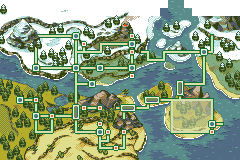 Nature Reserve
On this page
Where is the Pokemon Monomyth Nature Reserve?
The community map connects the Nature Reserve entrance building with Old Bay Island. Its reconstructed door chain leads from an island entrance into a small lobby, then from the lobby into the reserve. Use the regional locator for orientation and the linked community entrance marker for the detailed door position.
A map connection does not establish every story prerequisite. The reviewed entrance dialogue confirms admission and the fee, but does not by itself prove the first badge or story event that unlocks travel there. If you cannot reach Old Bay Island yet, continue your story route; do not interpret the reserve’s low-level encounters as evidence that it is an early-game destination.
What does Nature Reserve admission cost?
The published v1.1 dialogue asks for 10,000 in game currency for standard admission and calls the activity a Safari Game. That is a game expense, separate from this free website. Read the clerk’s prompt and your current money before agreeing; this page does not spend currency or start a game session.
The published admission dialogue explicitly asks you to buy Sport Balls at the counter before entering; do that before paying for the outing. The gift-shop dialogue confirms that it sells them. This does not establish an included ball allowance, a fixed time limit or the exact checkout price per ball. DexDB still labels its Sport-Ball-only and no-boss-aura interpretation unconfirmed, so read your own session’s prompts before a long hunt.
How do I use the Pokemon Monomyth Nature Reserve finder?
The list contains 54 distinct species and 60 species/method records. A Pokémon can appear under more than one method, so those totals answer different questions. Choosing a method hides unrelated rows as well as unrelated species. It does not reroll your game or make a species available outside its recorded method.
For example, Crackliss is a grass target in this reference, while Staryu is listed for Surfing. Search a name first, inspect its level and method, then compare the other available approaches. A blank result means this bounded reserve reference has no match under those filters; it is not a claim that the Pokémon is absent from all of Athanto.
- Enter a species name; accents and apostrophes are normalized for searching.
- Choose Grass, Surfing or one of the three rods and read the matching rows.
- Export JSON or TXT for an offline reference, or Reset to browse everything.
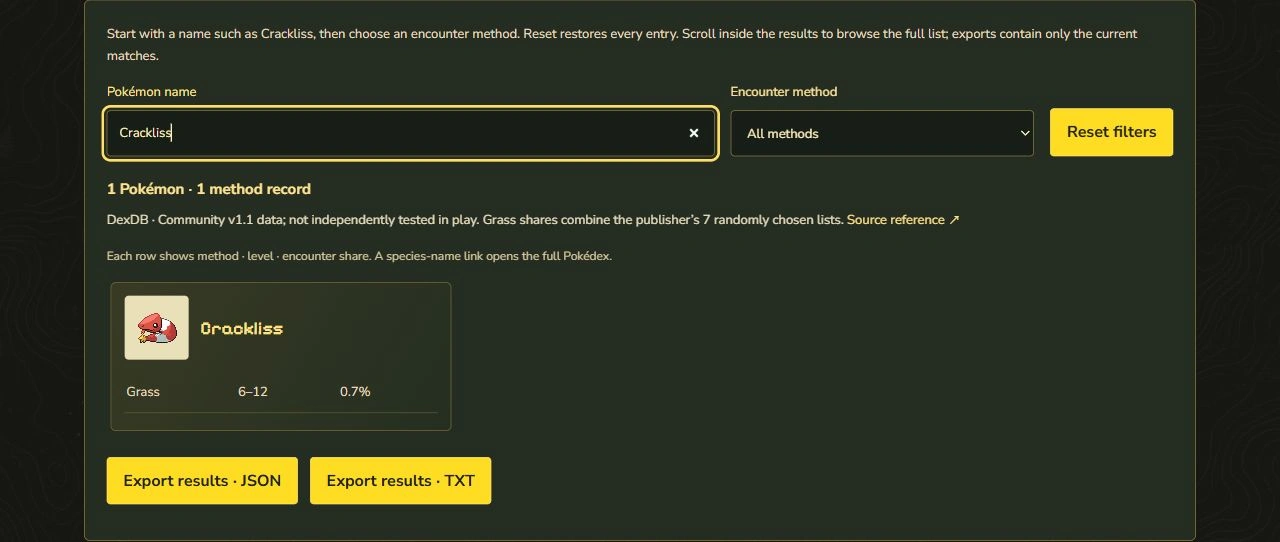
Crackliss search example: read the method, level and share together; the source’s encounter list is not a guarantee on your next visit.
Field Guide interface · example onlyOpen full-size image ↗What is saved or uploaded by this tool?
Searching, method filtering and file assembly happen locally in this browser. No account, payment, ROM, save file or friend code is required. JSON records the source, reference date, filters and matching encounter rows; TXT gives a compact readable list. Both are free downloads without a watermark. Neither file is an emulator configuration.
The finder does not save your catch progress or check your inventory. For a persistent seen/caught checklist, open the full Pokédex and use its existing local marks. Species images keep their existing v1.0 reference scope, while this encounter list is a community v1.1 reference; an image is not proof that every field came from the same build.
Questions, answered
Is the Pokemon Monomyth Nature Reserve finder free?
Yes. Search, filtering and JSON/TXT exports cost $0 and need no account. The game’s recorded 10,000 admission fee is separate.
Are there 54 species or 60 Pokémon?
There are 54 distinct species and 60 species/method rows in the reviewed reference. Some species occur under multiple methods.
Can I find Crackliss here?
The reviewed community v1.1 list includes Crackliss in grass at levels 6–12. Select or search it in the finder; reaching the area still has its own travel prerequisites.
Does a 0.7% entry mean a 0.7% catch rate?
No. It is a rounded encounter share for the stated method. Capture success, hidden abilities and shiny appearance are different questions.
Is the reserve available before the Pokémon League?
The reviewed sources do not establish the earliest story unlock. They connect its entrance to Old Bay Island. Low encounter levels do not prove early access.
Does this page guarantee a hidden ability?
No. The 7-in-10 statement is attributed to DexDB’s interpretation. We have not independently tested catches or established how every friend-code bonus stacks.
Why are there no results for my chosen rod?
Your name and method filters may exclude every recorded row. Reset or select All methods; this list covers Nature Reserve, not every game location.
Does an exported file change my save?
No. It is a text reference only. The tool does not read, upload, patch or modify game files.
Sources & verification scope
Checked November 11, 2026. Encounters, admission dialogue and door connections come from DexDB’s community v1.1 publication, not official documentation or our own gameplay test. Its exact probability implementation and earliest story unlock remain unverified. Existing species images retain their separately recorded v1.0 scope.